Aggregate Plan
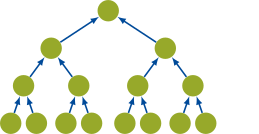
AggregatePlan describes the upward aggregation traversal on a tree. It specifies:
- which nodes are visited per level during aggregation,
- which node moments must be stored for later phases, and
This is a non-translating aggregation plan. Its counterpart for a matrix-vector product is DisaggregateTranslatePlan.
Building an AggregatePlan
Conceptually, AggregatePlan is built from a tree and a function aggregatenode(node).
- If
aggregatenode(node)istrue, that node is marked for storage. - If not, the node is still included in traversal when one of its ancestors is a storing node.
- Aggregation levels are organized from leaves toward the root.
This ensures aggregation paths remain complete for all moments that must be available later.
Fields
An AggregatePlan stores:
nodes: aggregation nodes grouped by level.levels: aggregation levels, ordered leaves-to-root.storenode: booleans indicating which node moments are stored.rootoffset: offset used to convert node ids to compact 1-based indices.tree: the tree associated with the plan.
Example
The example below constructs Galerkin plans in AggregateMode() and extracts the trial-side AggregatePlan.
plans = H2Trees.buildplans(
    tree;
    builder=H2Trees.PlanBuilder(;
        isnear=H2Trees.isnear(; additionalbufferboxes=1),
        aggregationmode=H2Trees.AggregateMode(),
    ),
)
aggregateplan = plans.trialaggregationplan
aggregateplan
AggregatePlan{TwoNTree{3, BoxData{3, Float64}, Float64, Base.RefValue{TreeIndex}}}([[66, 67, 68, 69, 70, 71, 72, 73, 74, 75 … 320, 321, 322, 323, 324, 325, 326, 327, 328, 329], [10, 11, 12, 13, 14, 15, 16, 17, 18, 19 … 56, 57, 58, 59, 60, 61, 62, 63, 64, 65]], 4:-1:3, Bool[0, 0, 0, 0, 0, 0, 0, 0, 0, 1 … 1, 1, 1, 1, 1, 1, 1, 1, 1, 1], 0, TwoNTree{3,Float64}(nodes=329, leaves=272, levels=1:4, root=1))